Nous Subscription
Eco
The Nous reading and study club, in your pocket.
You already know what you want to read. The problem was never the list: it was getting to the end of a difficult book alone, with no one on the other side waiting for you to finish the chapter. That's why the bookshelf grows faster than the reading.
Reading the classics is not a matter of discipline.
It's a matter of company.
Ecco is where reading stops being solitary. You enter a cycle, read at the group's pace, mark your progress and find people on the other side going through the same work in the same week.
from
R$ 34,99
per month
Two plans, monthly billing, cancel whenever you want.
Inside the app
What do you do at Ecco
It's not a video shelf with a padlock. It is the place where your reading takes place, and where it is recorded.
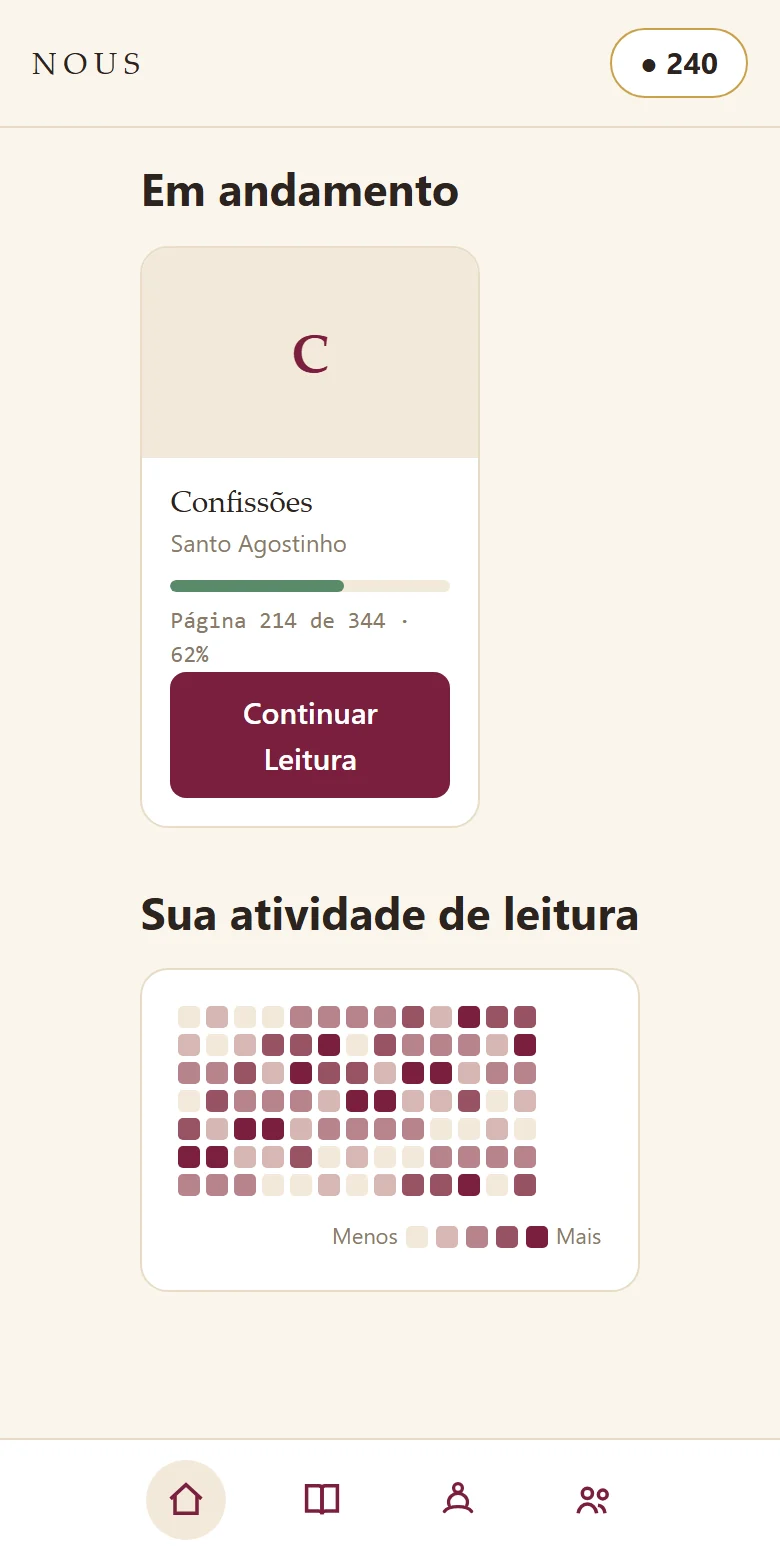
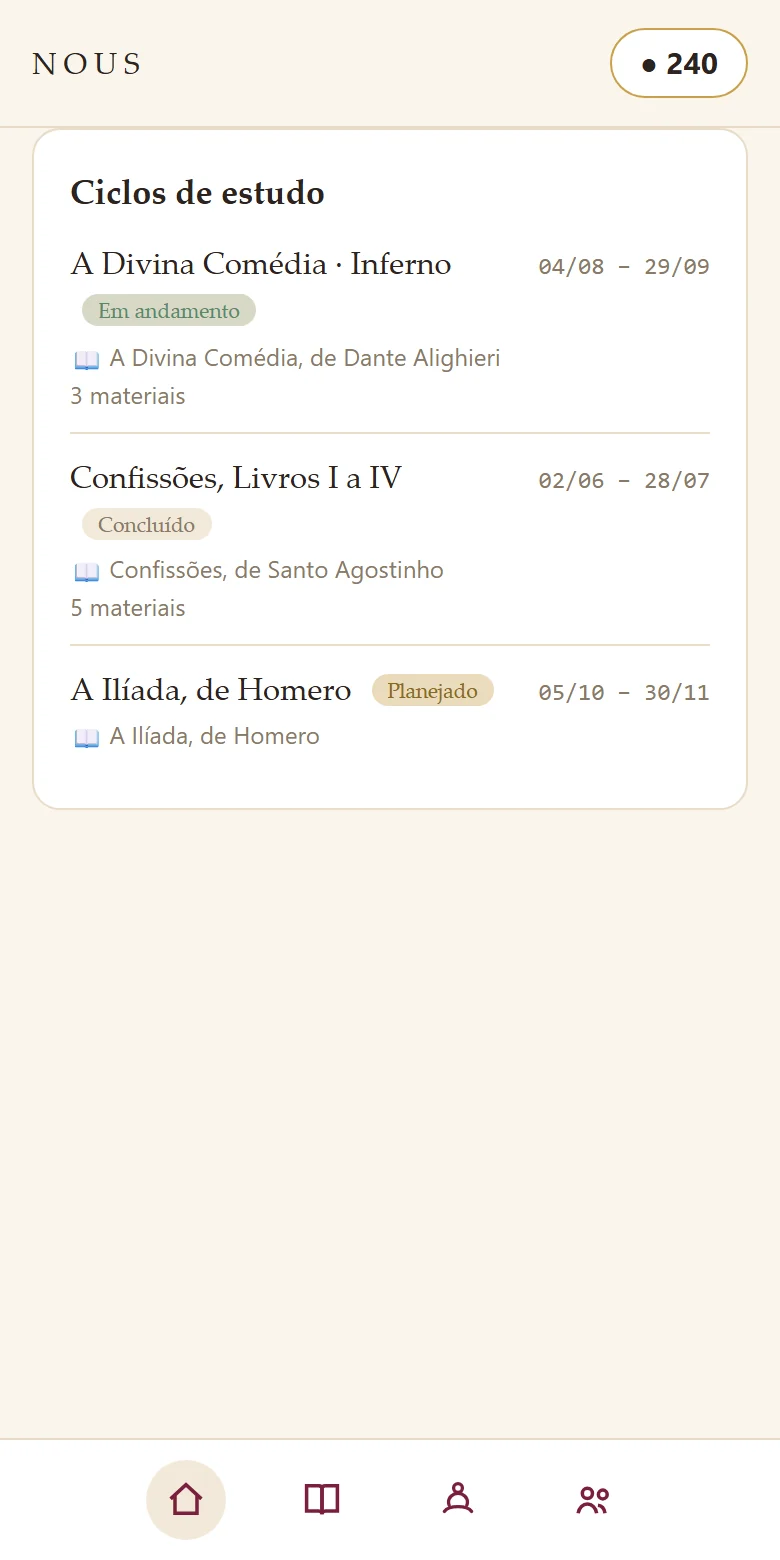
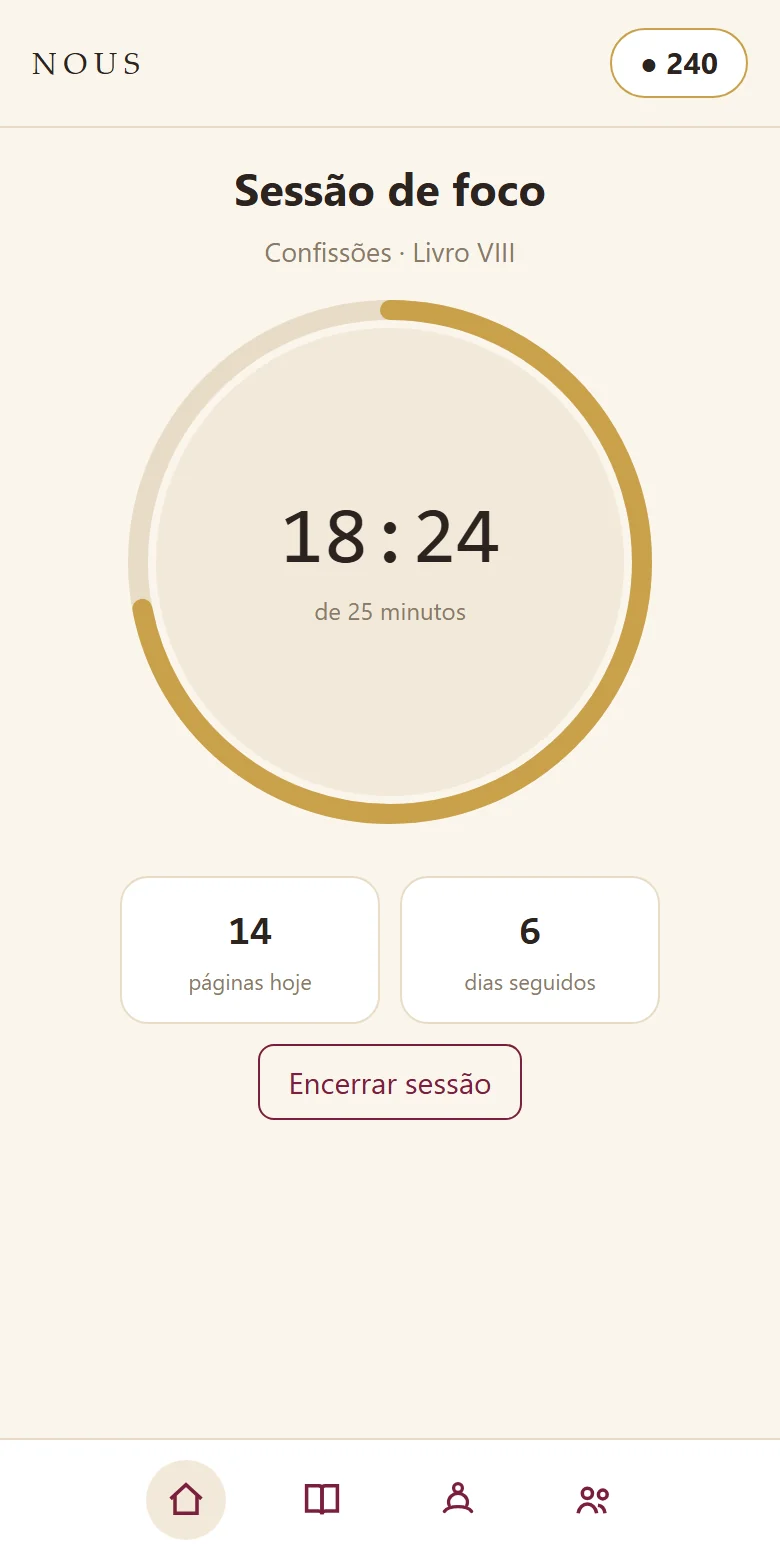
- Group reading cycles. Each group has its own work and rhythm, with the meeting material gathered in one place. You can participate in more than one.
- Progress per book. You mark how far you've read and see the bar fill up. What seems like detail is what keeps you coming back: a book with visible progress is harder to abandon halfway through.
- Notes and history. What you wrote stays in the book, not lost in a notebook that disappears. And the history shows what you read over the months, which is proof that things progressed.
- Focus sessions. A timer to actually sit down and read, with the rest of the screen moving out of the way as the session runs.
- Your library. What you are reading, what you have already read and what you want to read, organized by you.
The readings
It’s not just following the reading
The difference appears at the meeting. We didn’t limit ourselves to following the narrative or exchanging opinions about what each person felt. We investigate characters, ideas, context and conflicts, we put different works and authors in dialogue, and we ask what that still says about the world in which we live.
The goal is not to finish books. It's about forming a repertoire: leaving each work with something that changes the way you read the next one, and the way you look at what's happening now.
The next works
- The Red and the Black, by Stendhal. It starts now, in August.
- The Lord of the Rings, by Tolkien. In three cycles, one per volume.
- The Brothers Karamazov, by Dostoevsky. The novel that tends to be the turning point for those who read the author.
- The Magic Mountain, by Thomas Mann. Closes the sequence.
This list is a guide, not a contract. The order can change, and between one long work and the next we usually fit in a short book, so the group can breathe without losing pace. Those inside follow the calendar through the app.
On mobile
It becomes an app on your home screen
Don't look for it in a store, because it isn't in any. You open app.nouscast.com in your phone's browser and use “Add to Home Screen”, via the share button on iPhone or via the browser menu on Android.
From there it opens in full screen, with its own icon, like any other application. No download, no update to install, and no need to go to any store.
Nous Formation
And, if you want, the Nous Formation together
The complete plan opens the classes area, on Kiwify, with the same email as your subscription. That's where most of what we record lives. Not everything we produce goes on YouTube, and this is the difference that is worth understanding before subscribing.
One class per week
History of the Church and Pirandello release one class per week, counting from the day you subscribe. You enter at the beginning of the course, not in the middle of it, and you have the entire week to digest one class before the next.
Masterclass is the name of two things
The theology ones, like Psalms, Job and Maccabees, are split: part of them is released in the YouTube community, and the vast majority stays on the platform. The classical literature ones, like the Odyssey and the Iliad, are sold separately and go nowhere else, neither to the platform nor to the channel. If you want to watch one again, the recording is on sale on that masterclass's own page. In both cases, the live session is the only version where you ask, and your question changes the class.
Where each thing lives
- The open YouTube channel. Free for anyone, and stay free. He has a part of what we produce, never everything, and nothing here will stop being free.
- The YouTube community. It is a separate subscription, made within YouTube itself, for those who prefer to follow along there. What comes out in it is the Formation in Philosophy and Theology and part of the theology masterclasses. History of the Church and Pirandello do not go through it.
- The platform, which is what this plan opens. It holds most of it: History of the Church, Pirandello, the Formation in Philosophy and Theology, the theology masterclasses already held, and other classes we keep adding along the way.
And there is one thing that is in none of the three: the classical literature masterclasses, like the Odyssey and the Iliad. They are sold separately, each on its own page, and are not part of the subscription.
The plans
Two, and the difference between them is one
The two give the entire app and participation in their study group's live meetings. The R$ 64.99 one adds the classes area, where most of what we recorded and which is not on the open channel is located.
Study Group
R$ 34,99
per month
- The Ecco app, complete
- Group reading cycles
- Progress, notes and history
- Focus Sessions
Courses + Study Group
R$ 64,99
per month
- Everything from the previous plan
- History of the Church and Pirandello, one class per week
- Training in Philosophy and Theology
- The theology masterclasses, and the classes that keep coming in
Monthly billing. You cancel whenever you want, and access continues until the end of the paid month.
Questions