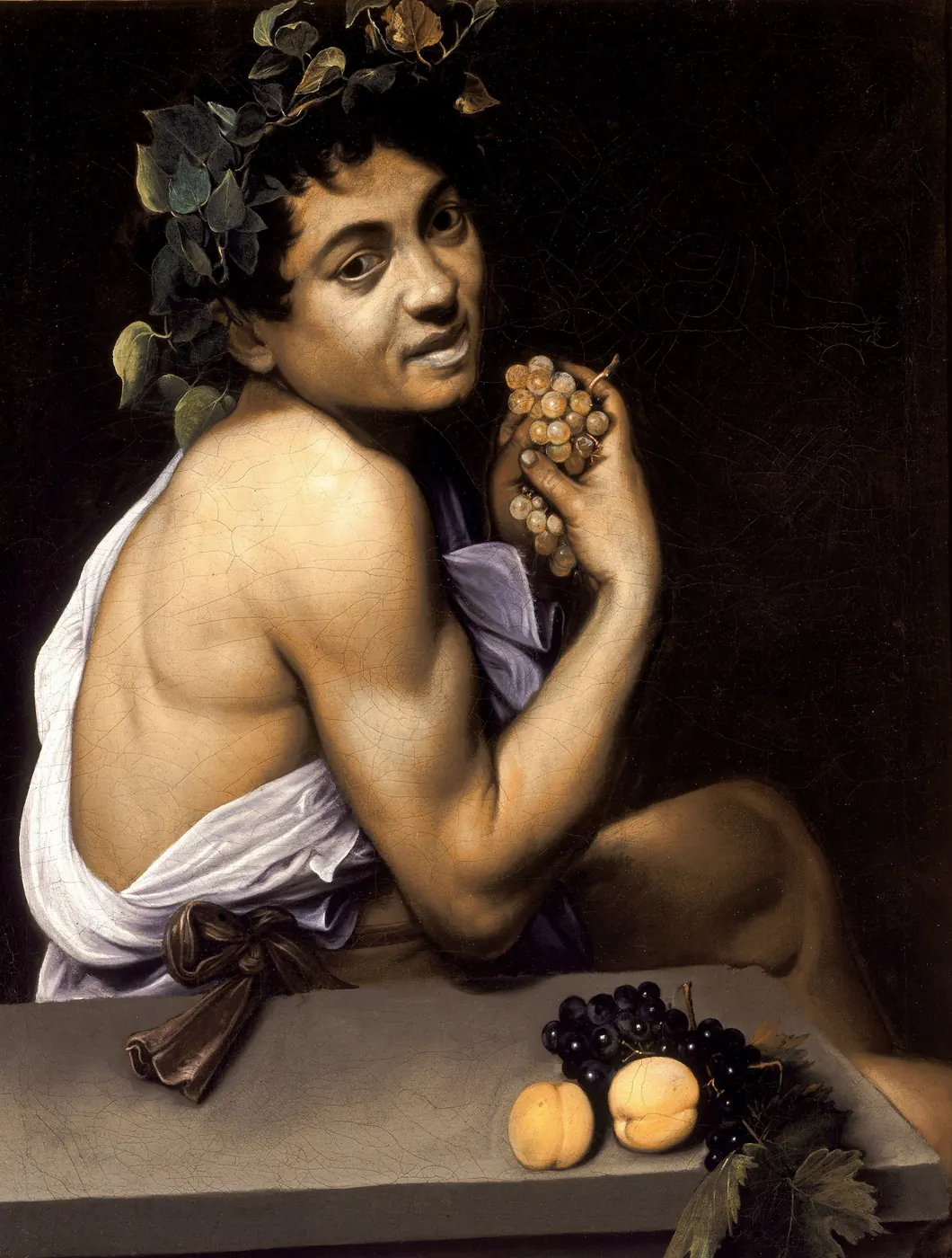
Around 1593, Caravaggio, aged 22, was admitted to the hospital of Santa Maria della Consolazione, in Rome, recovering from an injury. He asked for a mirror, looked at his own sick reflection and painted himself as Bacchus, the Greek god of wine and ecstasy.
A non-standard god
He is not the Bacchus of tradition, young, glorious, crowned with ripe grapes and golden skin. This one has the greenish skin of someone who hasn't left the house in weeks, his lips are dry, the grapes in his hand are already beginning to wilt, his eyes have the slightly dislocated shine of someone who has a fever. He is the god of ecstasy in a state of collapse.
The refusal of idealization
In 1593, the artistic rule was clear: to paint a god was to paint an ideal, perfect grapes, luminous skin, Olympian posture. Caravaggio looked at his own sick reflection and decided to paint what he saw, not what he should see. In doing so, he transformed fragility into a philosophical argument: illness does not contaminate the divine, it reveals it. A god who only appears in perfection is a god of the privileged; a god who appears in fever and weakness is a god anyone can recognize.
The bridge with Christian theology
The choice echoes an idea that Caravaggio, a man with deep religious training, knew well: Christ was not born in a palace, he was born in a stable, and he died naked, thirsty, on a cross. The Christian sacred, in its essence, is the sacred incarnated in vulnerability, and Caravaggio painted this idea before any formal Counter-Reformation theologian systematized it.
This piece came out of a place you can actually visit. To see it up close, with people who study these works and live among them, follow the link: the cultural immersion in Rome
Travelling to Rome? Private cultural experiences in Rome for groups of 1 to 6 people, guided in Portuguese, Italian or Spanish, at viaggioearte.com.
Readings from Nous
Read the classics in depth
Our list of more than 220 recommended books, commented and organized by theme, so you don't read in the dark.
See recommended readingsFrequently asked questions
What does Caravaggio's Little Sick Bacchus represent?
It is a self-portrait of Caravaggio himself, painted around 1593, at the age of 22, while recovering from an injury in the hospital of Santa Maria della Consolazione in Rome. He painted himself like the god Bacchus, but sick and pale.
Why does Bacchus appear sick in the painting?
Because Caravaggio refused the idealization that tradition demanded of a divine figure: instead of a young and glorious god, he painted his own greenish skin, dry lips and withered grapes that he saw when he looked in the mirror during his convalescence.
Where is Little Sick Bacchus today?
At the Galleria Borghese, in Rome, alongside five other works by Caravaggio.
Continue to the Caravaggio cluster: Who was Caravaggio? · Galleria Borghese and Caravaggio · Caravaggio and the Bible · The dreamers of European Romanticism
Source class (YouTube): Quem foi Caravaggio (NousCast)