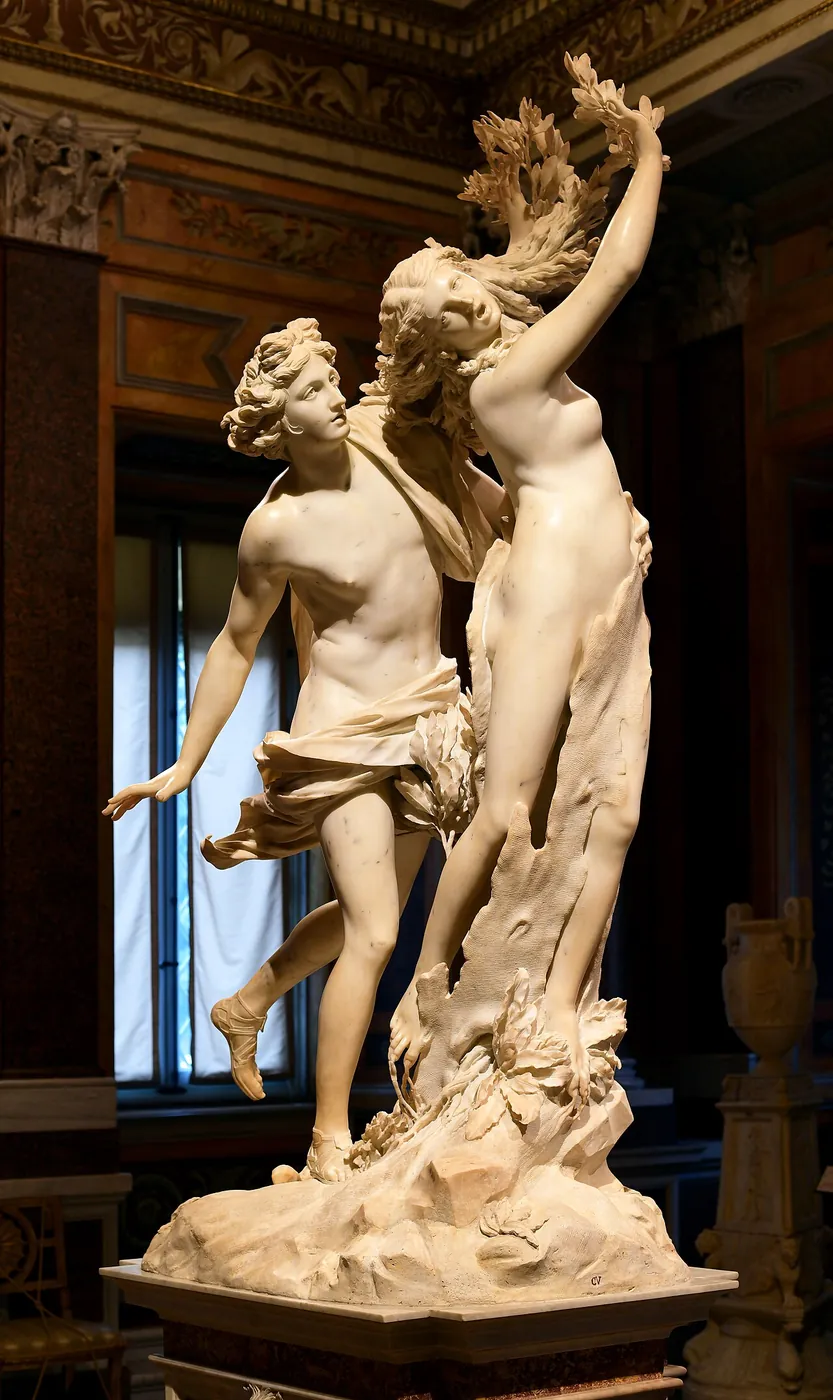
Apollo and Daphne is the effort to sculpt the most fleeting moment that exists: the last fraction of a second before something stops being what it was. Daphne's fingers have already become tree bark, her feet are already roots, her hair is already leaves, and her face is still that of someone who knows that she is ceasing to be human.
The myth, in Ovid's Metamorphoses
Ovid wrote the Metamorphoses around 8 AD, a fifteen-book poem with around 250 stories of transformation. In Book I, Apollo and Daphne appear: the god of the sun and prophecy, struck by an arrow from Eros, falls in love with Daphne, daughter of the river Peneus, struck by an arrow that provokes repulsion. She runs away, he pursues, and just as Apollo is about to catch up with her, Daphne asks her father to save her. Peneus transforms her into a laurel tree, her skin hardening into bark under the fingers of the god who still hugged her.
What Bernini sculpted, beyond the myth
Bernini read Ovid and turned into stone the moment that the poet had only described in words, between 1622 and 1625. But the sculpture carries a second layer: a statement about desire. Apollo, god, powerful and fast, arrives in time to touch what he loves, and the moment he touches it, it is no longer what he loved. Daphne was not captured. It was eternalized.
Why this scene continues to matter
The sculpture invites a question that goes beyond mythology: think of anything you have pursued intensely, a love, an ideal, a version of yourself. By the time you got close enough to touch, was it still what you were chasing? This is the meditation that Bernini left in marble, and that only fully opens up to those who know Ovid's poem behind it.
This piece came out of a place you can actually visit. To see it up close, with people who study these works and live among them, follow the link: the cultural immersion in Rome
Travelling to Rome? Private cultural experiences in Rome for groups of 1 to 6 people, guided in Portuguese, Italian or Spanish, at viaggioearte.com.
Readings from Nous
Read the classics in depth
Our list of more than 220 recommended books, commented and organized by theme, so you don't read in the dark.
See recommended readingsFrequently asked questions
What does Bernini's sculpture Apollo and Daphne represent?
It represents the exact moment of the transformation of the nymph Daphne into a laurel tree, at the moment when the god Apollo is about to reach her. It is a scene from Book I of Ovid's Metamorphoses, sculpted by Bernini between 1622 and 1625.
What is the story of Apollo and Daphne in myth?
Apollo, struck by a golden arrow from Eros, falls in love with Daphne, struck by a lead arrow that causes repulsion. Daphne flees, Apollo pursues, and when he is about to catch up with her, she asks her father, the river god Peneus, for help, who turns her into a laurel tree.
Where is the Apollo and Daphne sculpture?
In the Galleria Borghese, in Rome, along with other masterpieces by Bernini, such as Aeneas with Anchises and Ascanius and The Rape of Proserpina.
Continue on the Bernini cluster: Who was Bernini? · Aeneas, Anchises and Ascanius, by Bernini · The Abduction of Proserpina, by Bernini · Studying before traveling changes what you see
Source class (YouTube): Quem foi Bernini? (NousCast)