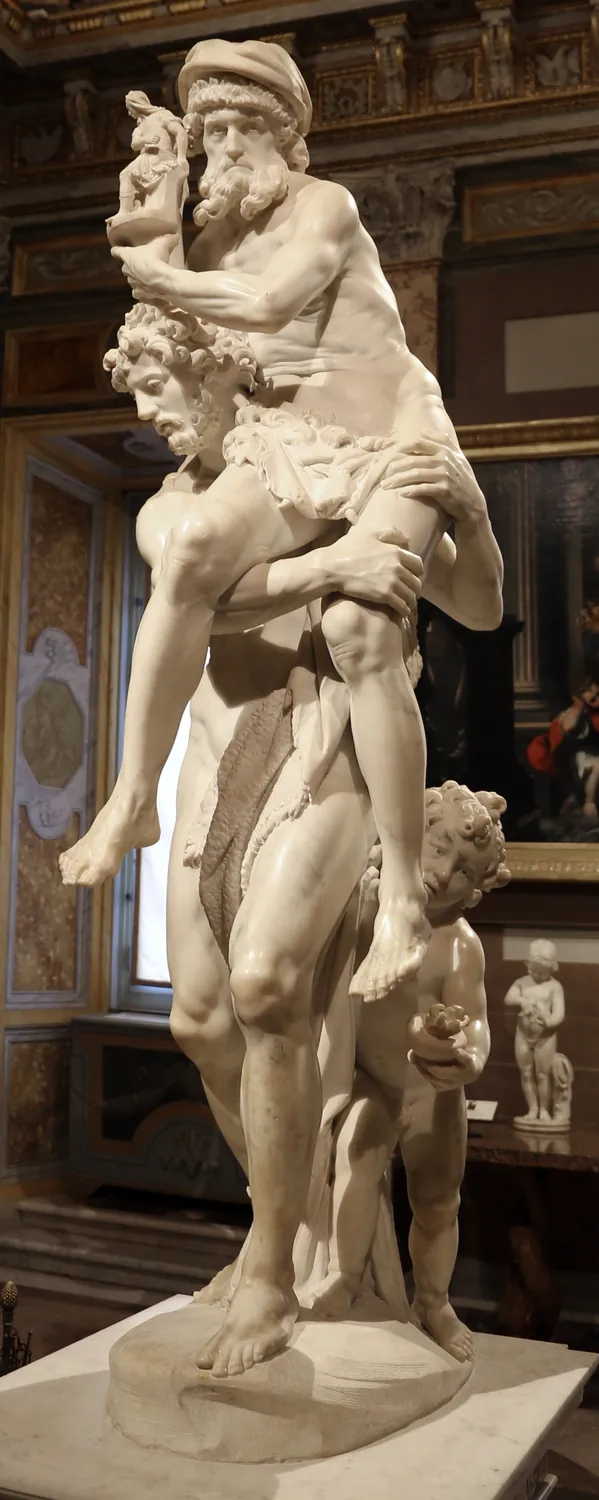
Three figures, one almost on top of the other: a young man carrying an old man on his back, a child running alongside. At first glance, a simple sculptural group. But when you know who these three figures are, the sculpture stops being a scene and becomes a thesis about what it means to inherit and found.
The scene, in Virgil's Aeneid
Virgil wrote the Aeneid between 29 and 19 BC, commissioned by Emperor Augustus: the foundational poem of Rome, the story of Aeneas, a Trojan warrior who flees the destruction of Troy and crosses the Mediterranean until reaching Latium. In Book II, with Troy in flames and the Greeks already inside the walls, Aeneas makes a choice that Virgil describes with maximum economy: he puts his elderly father, Anchises, on his back, takes his young son, Ascanius, by the hand, and walks through the flames. Load the past. Drives the future. Crosses the present in ruins.
What Bernini sculpted
Bernini was only twenty years old when he began this work, and the verticality of the three figures is no accident compositional: Ascanio below, Aeneas in the middle, Anchises above is a meditation on time, childhood, maturity and old age brought together in a single moving body. The future, the present and the past carried by the same man, at the same moment.
A founder definition
The sculpture proposes something that is valid for any era: greatness is not individual, it is generational. The hero is not the one who saves himself alone, he is the one who carries those who can no longer walk and protects those who still don't know where to go. In a culture that celebrates the self-made individual, Aeneas does the opposite, and Virgil, followed by Bernini, proposes that this is what, in fact, defines a founder: not who abandons the burden, but who carries it.
This piece came out of a place you can actually visit. To see it up close, with people who study these works and live among them, follow the link: the cultural immersion in Rome
Travelling to Rome? Private cultural experiences in Rome for groups of 1 to 6 people, guided in Portuguese, Italian or Spanish, at viaggioearte.com.
Readings from Nous
Read the classics in depth
Our list of more than 220 recommended books, commented and organized by theme, so you don't read in the dark.
See recommended readingsFrequently asked questions
What does the sculpture of Aeneas, Anchises and Ascanius represent?
It represents the moment when Aeneas flees burning Troy carrying his elderly father, Anchises, on his back, and leading his young son, Ascanius, by the hand. It is a scene from Book II of Virgil's Aeneid, sculpted by Bernini when he was just twenty years old.
What is the story of Aeneas in the Aeneid?
Aeneas is the Trojan warrior who, after the fall of Troy, flees across the Mediterranean and arrives in Latium, Italy, to found the people that would create Rome. Virgil wrote the poem between 29 and 19 BC, commissioned by Emperor Augustus.
Why does the vertical composition of the sculpture matter?
Ascanius at the bottom, Aeneas in the middle and Anchises at the top is no coincidence: it is a meditation on time, with childhood, maturity and old age brought together in a single moving body, the future, the present and the past carried by the same man.
Continue on the Bernini cluster: Who was Bernini? · Apollo and Daphne, by Bernini, and Ovid · The Abduction of Proserpina, by Bernini · Critical analysis is not a summary: what remains
Source class (YouTube): Quem foi Bernini? (NousCast)