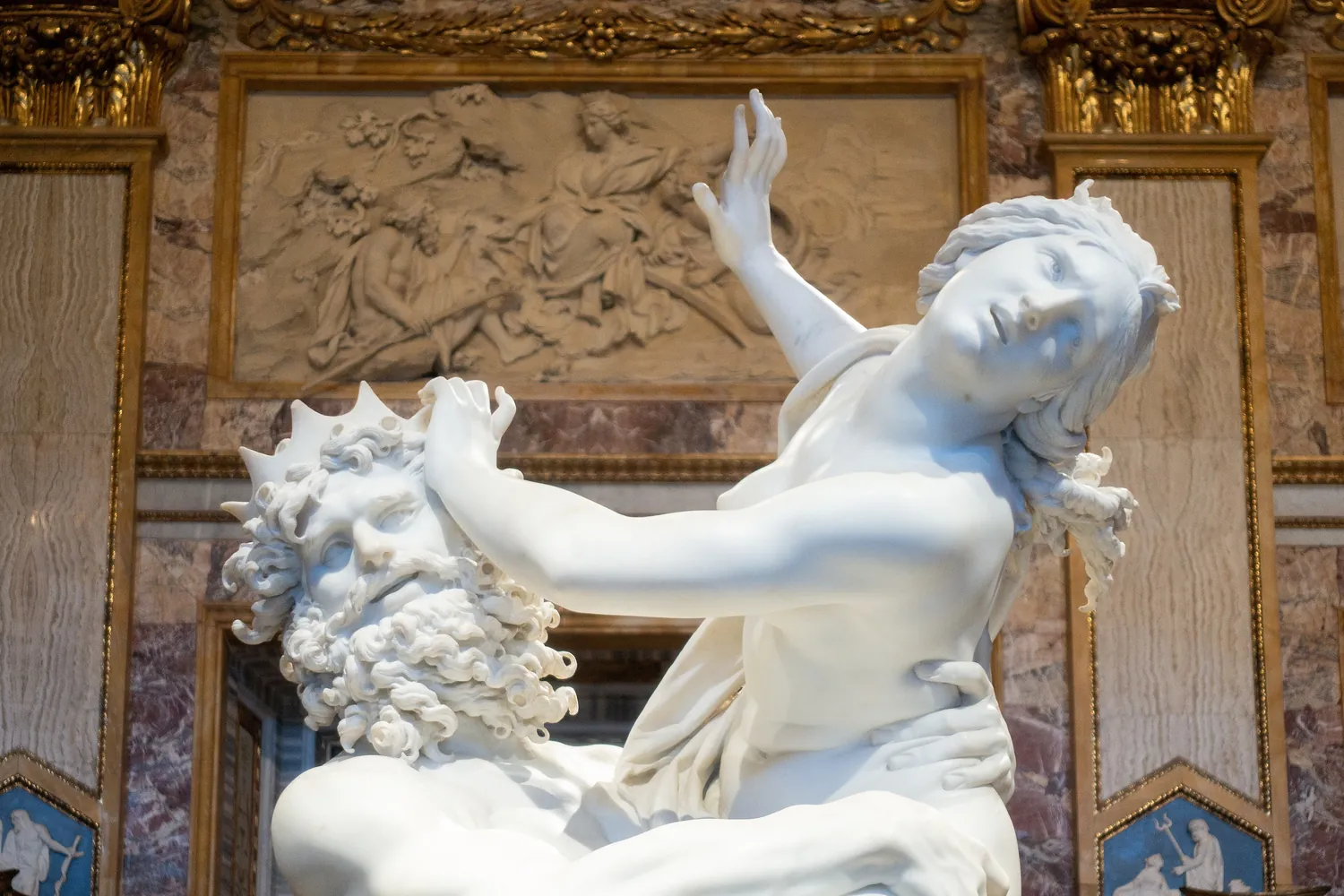
There is a detail that stops the world of anyone seeing this sculpture for the first time: the fingers of Pluto, god of the dead, sinking into the flesh of Proserpina's thigh. The marble appears to give way, which is technically impossible, and yet it is there.
The myth, in Book V of the Metamorphoses
Ovid tells the story in Book V of the Metamorphoses: Proserpina, daughter of Ceres, goddess of harvests, was gathering flowers in a meadow in Sicily when Pluto emerged from the depths and kidnapped her to the realm of the dead. Ceres, inconsolable, caused the earth to stop producing, and humanity began to starve. Jupiter, under pressure, negotiated: Proserpina would spend half the year in the underworld, with Pluto, and half in the world of the living, with her mother. From this negotiation, winter and summer would be born, the rest of the land and its abundance.
What Bernini chose to sculpt
Bernini, between 1621 and 1622, did not sculpt Pluto's triumph. He sculpted Proserpina's face, and that face is not one of resignation: it is one of active horror, her hands pushing the god with all the strength she has left. The choice humanizes the victim of the myth to the point that the viewer is unable to remain neutral in front of the scene.
The question that the sculpture raises
The work poses an old and permanent question: what happens when absolute power meets absolute freedom, when the force that moves the world does not ask for permission? Ovid doesn't respond, and neither does Bernini. Both do something more powerful: they force the viewer to feel the question in their body, before being able to think about it.
This piece came out of a place you can actually visit. To see it up close, with people who study these works and live among them, follow the link: the cultural immersion in Rome
Travelling to Rome? Private cultural experiences in Rome for groups of 1 to 6 people, guided in Portuguese, Italian or Spanish, at viaggioearte.com.
Readings from Nous
Read the classics in depth
Our list of more than 220 recommended books, commented and organized by theme, so you don't read in the dark.
See recommended readingsFrequently asked questions
What does Bernini's The Rape of Proserpina represent?
It represents the moment in which Pluto, god of the dead, kidnaps Proserpina, daughter of Ceres, and takes her to the underworld. It is a scene from Book V of Ovid's Metamorphoses, sculpted by Bernini between 1621 and 1622.
What is the story of Proserpina in myth?
Proserpina was picking flowers in a meadow in Sicily when Pluto kidnapped her. Ceres, her mother, goddess of harvests, made the earth stop producing out of sadness, until Jupiter negotiated an agreement: Proserpina would spend half the year in the underworld and half in the world of the living, the mythological origin of winter and summer.
Why is this sculpture considered technically impressive?
Because Bernini sculpted in hard marble the appearance of human skin yielding under pressure, Pluto's fingers digging into Proserpina's thigh, an effect that seems to contradict the rigidity of the stone itself.
Continue on the Bernini cluster: Who was Bernini? · Apollo and Daphne, by Bernini, and Ovid · Aeneas, Anchises and Ascanius, by Bernini · Moral dilemma: when no way out is clean
Source class (YouTube): Quem foi Bernini? (NousCast)